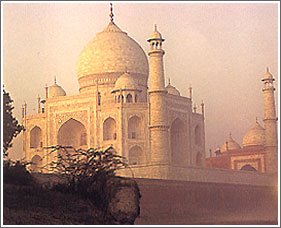
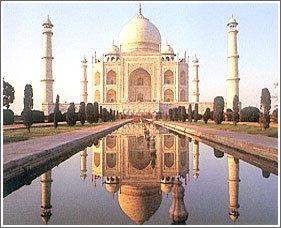
Taj Mahal, touted as one of the wonders of the world
and one of the most visited sites in the world.
It has also been said that it has perfect fengshui
being completely balanced in structure.
There is now another version of the story though not
as positive as we all know it to be.
Unfortunately, the source is unknown. Read it and
believe it or not as you will. Whatever, Taj Mahal
is still a dream destination for many of us.
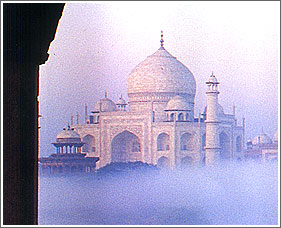


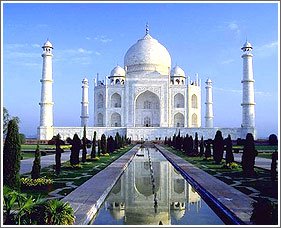


For centuries, the Taj Mahal has inspired poets, painters and musicians to try and capture its elusive magic in word, colour and song. It is one of the most flawless architectural creations of the world. Since the 17th century, travellers have crossed continents to come and see this ultimate memorial to love, and few have been unmoved by its incomparable beauty.
Taj Mahal stands in the city of Agra, in the northern Indian state of Uttar Pradesh, on the banks of the Yamuna River. It was built in the memory of the beautiful Arjumand Bano Begum, who won the heart of a Mughal prince. She was married at 21 to Emperor Jahangir’s third son Prince Khurram and stayed loyally by his side through good times and bad: in the luxurious royal palaces of Agra as well as the transient tents of war camps.
In AD 1628, Khurram became king after a bloody battle of succession: he took the name! Shahjahan or “King of the World” and showered his beloved begum with the highest titles. She became Mumtaz Mahal, the exalted of the palace and Mumtaz-ul-Zamani, the exalted of the Age. But Mumtaz Mahal was not destined to be queen for long.
In 1631, Shahjahan went on an expedition to the south and, as always, Mumtaz Mahal accompanied him. But she died in childbirth at Burhanpur. She had borne Shahjahan fourteen children, of whom four sons and three daughters survived. When Mumtaz Mahal died, she was just 39 years old. Shahjahan was inconsolable and contemporary chronicles tell of the royal court mourning for two years. there was no music, no feasting, and no celebration of any kind.
Epitome Of Love -Taj Mahal
Shahjahan, who was a passionate builder, now decided to erect a memorial to his queen in pristine marble that the world would never forget. The site selected for the tomb was a garden by the Yamuna river, unshadowed by any other structure. The garden had been laid by Raja Man Singh of Amber and now belonged to his grndson, Raja Jai Singh. By a royal firman, Shahjahan gave Jai Singh four havelis in exchange for the garden. The site was also chosen because it was located on a bend in the river, and so could be seen from Shahjahan’s personal palace in Agra Fort, further upstream.
Construction Of The Mausoleum - Taj Mahal
Work on the mausoleum! began in 1633 and 20,000 workers laboured for 17 years to build it. The most skilled architects, inlay craftsmen, calligraphers, stone-carvers and masons came from all across Indian and lands as distant as Persia and Turkey. The master mason was from Baghdab, an expert in building the double dome from Persia, and an inlay specialist from Delhi.
Yemen sent agates, the corals came from Arabia, the garnets from Bundelkhand, onyx and amethyst from Persia. Mumtaz Mahal’s final resting-place was ornamented like a queen’s jewel-box.
(Compiled by Jaya Prakash Rao)
*********************************************************
This is the other version though the source is unknown.The Mogul Emperor Shah Jahan in the memory of his wife
Mumtaz Mahal built the Taj Mahal. It was built in 22 years
(1631 to 1653)by 20,000 artisans brought to India from all
over the world. Many people believe Ustad Isa of Iran
designed it. This is what your guide probably told you if you ever
visited the Taj Mahal. This is the story I read in my
history book as a student in India. No one has ever
challenged it except Professor P.N.Oak, who believes
that the whole world has been duped. In his book
"Taj Mahal: The True Story", Oak says the Taj Mahal
is not Queen Mumtaz Mahal's tomb but an ancient Hindu
temple palace of Lord Shiva (then known as Tejo Mahalaya).
In the course of his research, Oak discovered the
Shiva temple palace was usurped by Shah Jahan from then
Maharaja of Jipur, Jai Singh. Shah Jahan then remodeled
the palace into his wife's memorial. In his own court
chronicle, Badshahnama, Shah Jahan admits that an
exceptionally beautiful grand mansion in Agra was taken
from Jai Singh for Mumtaz's burial. The ex-Maharaja of
Jaipur still retains in his secret collection two orders
from Shah Jahan for surrendering the Taj building.
Using captured temples and mansions, as a burial place
for dead courtiers and royalty was a common practice
among Muslim rulers. For example, Humayun, Akbar,
Etmud-ud-Daula and Safdarjung are all buried in such
mansions. Oak's inquiries begin with the name Taj Mahal.
He says this term does not occur in any Moghul court
papers or chronicles, even after ShahJahan's time.
The term "Mahal" has never been used for a building
in any of the Muslim countries, from Afghanistan to
Algeria.
"The unusual explanation that the term Taj Mahal derives
from Mumtaz Mahal is illogical in at least two respects.
First, her name was never Mumtaz Mahal but Mumtaz-ul-Zamani,"
he writes.
"Second, one cannot omit the first three letters 'Mum'
from a woman's name to derive the remainder as the name
for the building." Taj Mahal, he claims, is a corrupt
version of Tejo-Mahalaya, or the Shiva's Palace. Oak also
says the love story of Mumtaz and Shah Jahan is a fairy
tale created by court sycophants, blundering historians
and sloppy archaeologists. Not a single royal chronicle
of Shah Jahan's time corroborates the love story.
Furthermore, Oak cites several documents suggesting the
Taj Mahal predates Shah Jahan's era, and was a temple
palace dedicated to Shiva worshipped by the Rajputs of
Agra city. For example, Professor Marvin Miller of
New York took a few samples from the riverside doorway
of the Taj. Carbon dating tests revealed that the
door was 300 years older than Shah Jahan. European
traveler Johan Albert Mandelslo, who visited Agra in
1638 (only seven years after Mumtaz's death), describes
the life of the city in his memoirs. But he makes no
reference to the Taj Mahal being built. The writings
of Peter Mundy, an English visitor to Agra within a year
of Mumtaz's death, also suggest the Taj was a noteworthy
building long well before Shah Jahan's time.
Oak points out a number of design and architectural
inconsistencies that support the belief of the Taj Mahal
being a typical Hindu temple rather than a mausoleum.
Many rooms in the Taj Mahal have remained sealed since
Shah Jahan's time,and are still inaccessible to the public.
Oak asserts they contain a headless statue of Shiva and
other objects commonly used for worship rituals in Hindu
temples.
Fearing political backlash, Indira Gandhi's government
tried to have Oak's book withdrawn from the bookstores,
and threatened the Indian publisher of the first edition
with dire consequences.
There is only one way to discredit or validate Oak's
research. The current Indian government should open the
sealed rooms of the Taj Mahal under UN supervision, and
let international experts investigate.